


Picture this: three people sitting together at a diner, having a conversation. Two of them are looking at their phones. The person talking is speaking into a void — present in the room, but largely alone in the exchange. It’s a scene that has become so common we barely notice it anymore. And that normalization is exactly what makes it worth paying attention to.We’ve all been on both sides of this. We’ve been the one speaking to someone whose eyes keep drifting to a screen. And if we’re honest, we’ve been the one drifting. The phone is always there, always pulling, always offering something that feels vaguely urgent. What we rarely stop to consider — especially as leaders — is what we’re actually giving up every time we let it win.
Presence Is a Leadership Skill — and It’s in Decline
Full presence — the ability to give another person your complete, undivided attention — is one of the most powerful things a leader can offer. It signals respect. It builds trust. It creates the psychological safety that allows people to share openly, think clearly, and bring their best thinking to the conversation. And it is, by most measures, becoming increasingly rare.
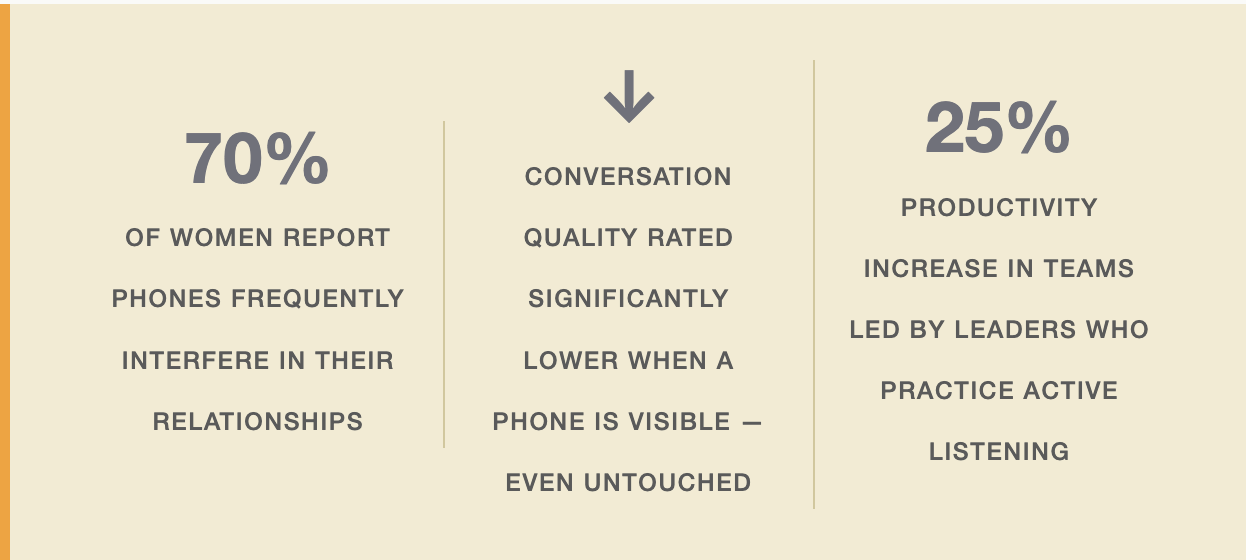
Research from the Greater Good Science Center at UC Berkeley found that conversations with no smartphones present are rated as significantly higher quality than those with phones nearby — regardless of age, gender, or mood. The effect is especially pronounced during meaningful conversations, where the presence of a phone directly undermines feelings of closeness, connection, and trust. And here’s the part that should give every leader pause: the phone doesn’t have to be in your hand. Simply having it visible on the table is enough to reduce the perceived quality of the exchange.
A separate study published in Science Direct found that phone presence during meaningful conversations leads to lower ratings of trust, perceived empathy, and relationship quality. When a leader checks their phone mid-conversation — even briefly — they send a message that something else is more important. And people remember that message long after they’ve forgotten the words.
What “Fully Present” Actually Means
Being fully present isn’t simply about putting the phone away. It’s a more complete discipline — one that involves body language, mental focus, and genuine curiosity about the person in front of you. Most of us, even when we’re not looking at a screen, are only partially present. Part of our attention is elsewhere: rehearsing our next point, problem-solving the issue being raised, thinking about the next meeting, managing our own reaction to what’s being said.
Jim Loehr and Tony Schwartz, in their foundational research compiled in The Power of Full Engagement, found a strong correlation between the most effective corporate leaders and elite athletes — and a key shared characteristic was the ability to be fully present in the moment that matters. This isn’t a passive state. It’s an active discipline, one that has to be practiced and protected.
True presence means:
- —Silencing the internal monologue — not preparing your response while the other person is still speaking
- —Getting genuinely curious — asking follow-up questions instead of jumping to conclusions or solutions
- —Listening for what isn’t said — paying attention to tone, hesitation, and the gaps between words
- —Making the other person feel like the most important person in the room — because in that moment, they should be
That last point deserves to stand alone. The ability to make another person feel genuinely seen and heard — to be the most important person in the world at that moment — is not a soft skill. It is one of the most powerful things a leader can do to build trust, deepen relationships, and create the conditions for honest, productive dialogue.
“When leaders actively listen, they display respect and value for their team members’ contributions, encouraging a sense of inclusion and trust — which leads to more honesty in communication and collaboration.”— CXE Inc., The Power of Active Listening in Effective Leadership
The Leadership Cost of Distraction
For leaders specifically, the stakes of distraction are higher than they might appear. When a team member brings a problem, an idea, or a concern to a leader who is visibly distracted, the message received isn’t just “you’re not listening right now.” It’s “your ideas aren’t worth my full attention.” Over time, that message compounds. People stop bringing the problems early, when they’re still manageable. They stop surfacing the ideas that might feel risky to share. They stop giving honest feedback, because the implicit signal is that it won’t truly be heard.
Research published in the National Institutes of Health found a significant positive relationship between a supervisor’s active-empathetic listening and employee work engagement — with dedication being the dimension most strongly affected. In other words, how well a leader listens directly shapes how committed their people are to their work. Distraction isn’t just impolite. It’s expensive.
Leadership researcher David Burkus notes that active listening begins with eliminating distractions and being fully present — and that when team members feel a leader is truly with them, they are significantly more likely to share openly and trust that their ideas are valued. The inverse is equally true: when people sense they are competing with a device for a leader’s attention, they disengage. Not always visibly, but definitively.
Presence as a Competitive Advantage
Here is the opportunity hidden inside this challenge: because distraction has become so normalized, full presence has become rare — and rare things become differentiating. The leader who consistently puts the phone away, makes eye contact, asks curious questions, and gives people their full attention stands out. People remember how they felt in that conversation. They walk away feeling valued. They bring more of themselves to the next one.
This is not a small thing. The leaders and organizations that build the deepest reservoirs of trust are the ones where people feel genuinely heard at every level. That trust becomes a meaningful competitive advantage — in talent retention, in team performance, in the quality of thinking that surfaces in meetings, and in the willingness of people to bring their real concerns before they become real problems.
The Humphrey Group’s research on listening and leadership emphasizes that mastering the physical, mental, and emotional dimensions of active listening transforms interactions — leading to more aligned, empathetic, and productive teams. The starting point for all of it is deceptively simple: be there. Actually be there.
Practical Steps for Leaders Who Want to Lead with Presence
How to Be More Fully Present — Starting Today
- Phone away, not just face-down. Research shows that even a visible phone reduces conversation quality. When you’re in a meaningful exchange, remove it from the table entirely. The signal it sends — in both directions — is worth more than any notification you might miss.
- Resist the solution reflex. When someone brings you a problem, your instinct as a leader may be to solve it immediately. Resist. Ask another question first. Stay in understanding mode longer than feels natural. The solutions you arrive at after truly listening are almost always better than the ones you form before you’ve fully heard.
- Get curious, not just attentive. Presence isn’t passive. It’s active curiosity — wanting to know more, understand more deeply, and follow the thread of what the other person is actually saying rather than what you expected them to say.
- Set an intention before conversations. Before a one-on-one, a team meeting, or any significant exchange, take ten seconds to set a simple intention: be fully here. It sounds almost too simple. It works.
- Notice when you drift — and return. Full presence is a practice, not a state you achieve permanently. The discipline isn’t staying present perfectly. It’s noticing when you’ve drifted and returning, without judgment, to the person in front of you.
None of this requires new technology, additional training, or organizational initiatives. It requires a decision — made repeatedly, in the small moments of every day — to treat the human being in front of you as the most important thing in that moment. Because in that moment, they are.
The phone will still be there after the conversation. The opportunity to lead with genuine presence will not.
Develop Leaders Who Are Truly Present
Dame Leadership helps executives build the communication skills, habits, and self-awareness to lead with greater presence, trust, and impact. Contact us today.