


Here is a truth that every leader eventually has to reckon with: your organization already has a culture. It existed before you articulated your values. It existed before you ran your first all-hands meeting or posted your mission statement on the wall. Culture isn’t something an organization creates — it’s something that emerges, continuously and inevitably, from the daily decisions, behaviors, and interactions of the people inside it.
The only real question is whether that culture is developing with your intentional involvement — or without it. We’ve had this conversation with many leaders over the years. One that stands out: a CEO overseeing thousands of employees across 24 locations and an 88-person leadership team who, five years ago, made a deliberate decision to develop the culture he wanted rather than manage the one that had formed on its own. When we asked what prompted that shift, his answer was direct: he had come to realize that culture was happening with or without him — and that as a leader, that was no longer acceptable.
His experience is one we see repeated across the organizations we work with. And it points to what may be the most important leadership responsibility that often goes unaddressed: building culture with intention.
The Cost of a Culture Left to Chance
Leaders who are focused on results, strategy, and operations often treat culture as a soft concern — something that matters, but can be addressed later, once the more pressing work is done. The research suggests this is a costly miscalculation.
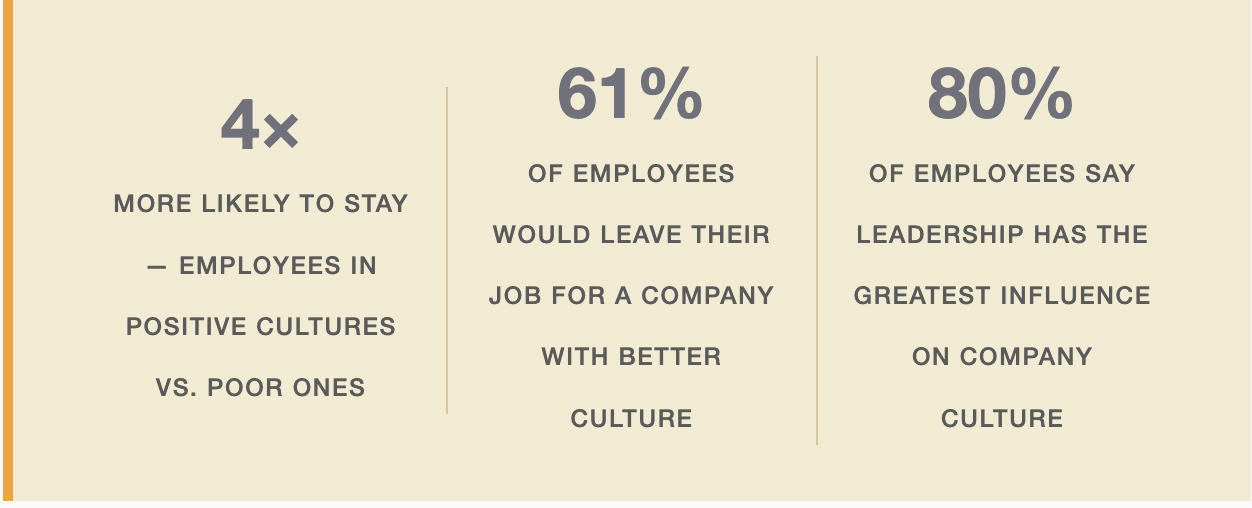
SHRM’s Global Workplace Culture report found that workers in positive organizational cultures are nearly four times more likely to stay with their employer. Meanwhile, Gallup’s 2025 data shows global employee engagement fell to 21% — the lowest since the pandemic — costing the global economy an estimated $438 billion in lost productivity. And 45% of employees cite toxic work environments as the number one reason they quit.
The message is clear: culture isn’t a peripheral concern. It’s a primary driver of the outcomes leaders care most about — retention, performance, engagement, and organizational resilience. When it’s left to develop without leadership input, the results are rarely what anyone would have chosen.
“Culture isn’t what’s written — it’s what’s lived. If values and behaviors aren’t reflected in daily decisions, they lose credibility.”— Quantum Workplace, 2025 Workplace & HR Trends Report
The Shift from Lip Service to Leadership
The leader we spoke with used a phrase that stuck with us. He said that for years, he had “paid lip service” to culture — acknowledging its importance in meetings and communications, but never making it a genuine operational priority. Sound familiar? Most leaders do this, not out of negligence, but because culture is genuinely hard to operationalize. It doesn’t fit neatly on a spreadsheet. Its effects are difficult to attribute directly to any single initiative. And building it requires a sustained commitment that competes with every other urgent demand on a leader’s time.
What changed for him — and what we observe in the leaders who build the strongest cultures — was a shift in understanding. Culture stopped being something to communicate and started being something to lead. The difference is significant. Communicating culture means putting values on a wall and hoping people absorb them. Leading culture means making decisions that are visibly consistent with those values, holding others accountable to them, and returning to them week after week, even when no one is watching.
Teneo’s research on CEO culture ownership notes that a set of values displayed anywhere in an organization does not constitute a culture. Culture is a collection of shared behaviors — and changing culture means changing those behaviors, consistently and over time, starting at the top.
What Intentional Culture Development Actually Looks Like
Intentional culture development isn’t a one-time initiative or an annual offsite exercise. It’s an ongoing practice that requires the same discipline and structure as any other strategic priority. Here’s what it looks like in practice:
1. Start with a culture audit — not a vision statement
Before you can build the culture you want, you have to understand the one you have. Anonymous employee surveys, engagement data, and turnover patterns tell you where there’s a gap between stated values and lived experience. SHRM recommends beginning with concrete data: engagement results, absenteeism figures, and trends across departments. This baseline is what makes culture development strategic rather than aspirational.
2. Define culture in behavioral terms, not abstract values
Values like “integrity” and “innovation” mean almost nothing without behavioral definition. What does integrity look like in a difficult client conversation? What does innovation look like in a Monday morning team meeting? The most effective culture programs translate values into observable, repeatable behaviors that leaders can model and that employees can recognize. When everyone in your organization can name not just your values but what those values look like in action, culture becomes self-reinforcing.
3. Involve the leadership team — deeply and early
Culture cannot be delegated to HR. It has to be owned at the leadership level. Research from SHRM Linkage consistently shows that workers with highly effective managers are more than twice as likely to feel a deep sense of commitment and belonging. The leader we spoke with built his culture program with his 88-person leadership team — not for them. That distinction matters enormously. When leaders are co-creators of the culture, rather than recipients of a rolled-out program, their buy-in and their behavioral modeling follow naturally.
4. Reinforce it weekly — not annually
The leader we spoke with reinforces his culture program every week, five years on. That kind of consistency is exactly what the research calls for. Quantum Workplace’s 2025 Trends Report found that culture drifts when it’s disconnected from strategy and daily operations — and that even the strongest cultures erode under pressure when not actively reinforced. Culture lives in the small, repeated moments: how meetings are run, how feedback is given, how conflicts are resolved, how leaders respond when no one else is looking.
5. Expect some eye-rolling — and lead through it
The leader we spoke with acknowledged that culture conversations can generate skepticism, especially in the early stages. His response: he accepted the eye-rolling because what mattered more was that everyone could see culture was a genuine leadership priority — not a flavor-of-the-month initiative. This is a posture every leader building culture needs to adopt. Sustainable culture change doesn’t require unanimous enthusiasm from day one. It requires consistent leadership behavior that, over time, makes the culture visible and credible through lived experience rather than declared intention.
The Leader’s Role Is Not Optional
One of the most important insights from both our work with organizations and the broader research is that leadership is not simply one of many influences on culture — it is the dominant one. 80% of employees say leadership has the greatest influence on workplace culture, more than any other organizational factor. Leaders don’t just set direction — they set behavioral norms. They signal, through their daily choices, what is valued, what is tolerated, and what is expected.
This means that a leader who is disengaged from culture isn’t neutral — they’re actively shaping it in ways they haven’t chosen. The culture is being built by default, around whatever patterns of behavior happen to dominate in the absence of intentional leadership. And those patterns tend to reflect the lowest common denominator rather than the highest aspiration.
Culture and Resilience: The Post-Pandemic Test
The past several years have stress-tested every organization’s culture in ways that no strategic plan fully anticipated. Remote and hybrid work fractured the informal moments — the hallway conversations, the casual connections — that had always quietly reinforced shared norms. Turnover disrupted institutional memory. And the broader uncertainty of the period put pressure on even the most intentionally built cultures.
What we consistently observed is that organizations with intentional, deeply embedded cultures recovered faster and sustained performance better than those where culture had been left to develop organically. When the informal scaffolding fell away, what remained was either a deliberately built framework or a vacuum. Leaders who had been actively shaping their cultures had something to return to. Those who hadn’t were starting from the beginning — in the middle of everything else.
The lesson is not that culture development is easy. It isn’t. But the cost of neglecting it — in turnover, disengagement, misalignment, and organizational fragility — is consistently higher than the investment required to build it intentionally.
Signs Your Culture Needs More Intentional Leadership
- Your stated values don’t visibly connect to how decisions are actually made
- Culture conversations feel performative rather than substantive to your team
- You’re losing strong performers without a clear understanding of why
- Different locations, teams, or departments feel like completely different organizations
- Leaders at the mid-level don’t see themselves as culture carriers
- Your culture program launched with energy — but hasn’t been actively reinforced since
Culture development is among the most important and most underinvested leadership disciplines. It requires more than good intentions. It requires structure, consistency, leadership alignment, and the willingness to be held accountable to the values you say matter — especially in moments when doing so is inconvenient.
At Dame Leadership, this is work we do alongside organizations every day. We help leaders move from acknowledging culture’s importance to building the systems, habits, and accountability structures that make it real and lasting.
If your organization’s culture is developing — and it is — the only remaining question is whether you’re the one leading it.
Ready to Build Your Culture With Intention?
Whether you’re building culture from scratch or strengthening what already exists, Dame Leadership gives you the framework, the tools, and the partnership to make it real. Contact us today.