


You know a real conversation when you’ve had one. There’s a quality to it that’s hard to describe — a sense that something genuinely shifted, that perspectives were tested, that you left the exchange thinking differently than when you entered it. It’s rarer than it should be, and most leaders know it.
At Dame Leadership, we had one of those conversations recently. Our team challenged the thinking behind our own priorities for the coming quarter — not to be difficult, but because that’s what high-trust teams do. They push back. They ask why. They surface the assumptions a leader might not see because they’re too close to them. The result was better clarity, better alignment, and better outcomes. That’s exactly what a real conversation is supposed to produce.
The question worth asking — for any leader — isn’t whether real conversations are valuable. They clearly are. The question is: why don’t they happen more often, and what can leaders do to create the conditions where they become the norm rather than the exception?
Why Real Conversations Are So Rare
Research from Harvard Business School professor Amy Edmondson has established that psychological safety — the belief that you can speak honestly without being punished or dismissed — is one of the strongest predictors of team performance. Her research shows that teams with high psychological safety are significantly more likely to avoid major operational errors, surface better ideas, and sustain high performance over time. And yet, by most measures, most organizations don’t have it.
The reason isn’t usually that leaders are unwilling to hear hard truths. More often, it’s that the conditions for honest dialogue were never explicitly built. People read the room. They calibrate their candor based on what they’ve seen happen to others who spoke up. When honesty has been met with defensiveness, dismissal, or consequence — even once — the message is absorbed quietly by everyone in the room. Real conversations become rarer. Important information stays unspoken. And leaders find themselves making decisions in a partial-information environment, wondering why their best thinking keeps running into the same obstacles.
The good news: this is a solvable problem. But it requires leaders who are intentional about how they show up in conversation — not just what they say, but how they listen, how they respond to challenge, and how they make it safe for others to be direct with them.
“The quality of our most crucial conversations determines the quality of our relationships, careers, and organizations.”— Crucial Conversations, Patterson, Grenny, McMillan & Switzler
Six Steps to Better, More Honest Conversations
These aren’t theoretical frameworks — they’re practical disciplines that any leader can begin applying immediately. Each one addresses a specific point where real conversations tend to break down.
1. Recognize when a crucial conversation is happening
Not every exchange is a crucial conversation. But some are — and the leaders who navigate them best are the ones who recognize them in real time and shift their approach accordingly. Researchers Kerry Patterson and Joseph Grenny, authors of the widely-used Crucial Conversations framework, define a crucial conversation as any discussion where stakes are high, opinions vary, and emotions run strong. The moment you sense those conditions, that’s your cue to slow down, become more intentional, and be more present. If you have time to prepare beforehand, think clearly about the outcome you want — not just what you want to say, but what you want the conversation to actually produce.
2. Be fearless
Fear is the most common reason real conversations don’t happen. Fear of how the other person will react. Fear of damaging the relationship. Fear of being wrong, or of being right in a way that creates conflict. These fears are understandable — but they carry a hidden cost. Every time a leader avoids a necessary conversation, the unspoken truth accumulates. Trust quietly erodes. Small problems that could have been addressed early become entrenched patterns that are far harder to correct. Being fearless doesn’t mean being reckless. It means trusting that the relationship is strong enough to handle honesty — and that if it isn’t, the conversation is even more necessary.
3. Seek to understand — get genuinely curious
One of the most powerful shifts a leader can make in a difficult conversation is to move from advocacy to inquiry. Instead of entering with a position to defend, enter with questions to ask. Curiosity changes not just what you say, but how you hold yourself — your body language, your tone, your openness to being surprised by what you hear. It signals respect. It communicates that the other person’s perspective has value. And practically, it produces better outcomes: decisions made with more complete information, rooted in a fuller understanding of the situation. Research from the Center for Creative Leadership shows that managers who engage in active listening and personalized inquiry foster significantly higher levels of psychological safety in their teams.
4. Understand how people respond to conflict
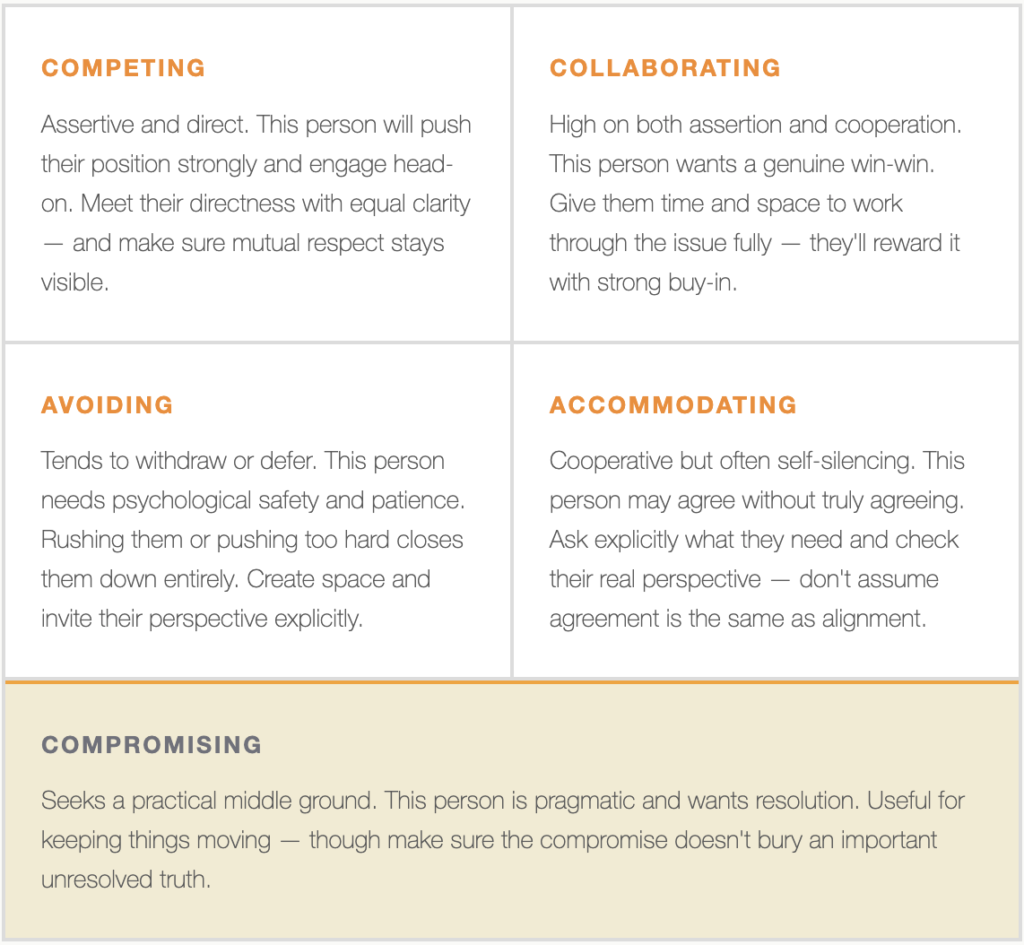
Not everyone enters a difficult conversation the same way. Some people get direct and confrontational when under pressure. Others go quiet, withdraw, or disengage entirely. Neither response is wrong — they’re simply different behavioral patterns under stress. Understanding this is critical, because a strategy that works for one person will completely miss another.
The Thomas-Kilmann Conflict Mode Instrument (TKI) — developed by researchers Kenneth Thomas and Ralph Kilmann — provides a research-validated framework for understanding five distinct ways people respond when conflict arises. Knowing where someone tends to land on this model allows you to adapt your approach, meet them where they are, and dramatically improve the quality of what gets exchanged.
5. Be candid — but be caring
Candor is a leadership virtue. But candor without care is just bluntness, and bluntness has a way of shutting down the very conversations it’s supposed to open up. The goal is not to say whatever you think, whenever you want. The goal is to be honest in a way the other person can actually receive. That means being thoughtful about timing, about context, about the relationship. It means asking not just “is this true?” but “is this useful to say right now, and in this way?” This is the discipline that separates leaders who are trusted for their directness from those who are merely feared for it. Being honest and being kind are not competing values — they are, in the best leaders, deeply integrated ones.
6. Listen without formulating your response
This is perhaps the hardest skill on this list — and probably the most important. Most of us, in the middle of a significant conversation, are only partially present. Part of our attention is on what the other person is saying; the rest is already composing our reply. The problem is that the person talking can feel that. They can sense when they’re being truly heard versus when they’re simply waiting for their turn to stop so the other person can speak. Real listening — the kind that builds trust and produces insight — requires setting aside the need to have a ready answer. It requires tolerating the discomfort of not knowing what you’ll say next. It is, in many ways, an act of respect. And it consistently produces better outcomes than any amount of well-prepared rebuttal.
“You don’t need to be the smartest person in the room. You can listen, take a moment to digest, and think about what you’re going to say next. If you’re truly engaged, they’ll feel it — and the conversation will go much better.”— Dame Leadership
The Leader’s Role: Creating the Conditions
These six disciplines are powerful at the individual level. But their real impact is organizational. When leaders consistently model these behaviors — when they show up curious, candid, fearless, and genuinely listening — they signal to everyone around them what kind of conversations are expected and valued here. That signal accumulates over time into culture.
Edmondson’s research found that teams with open communication are 50% more likely to avoid major operational errors. Organizations where leaders prioritize trust and honest dialogue see measurably lower turnover and stronger performance. The data is clear: real conversations are not a soft leadership aspiration. They are a hard business advantage.
The leaders who build this culture don’t do it by mandating honesty or installing feedback mechanisms. They do it by being the first ones to ask hard questions — and by receiving hard answers without flinching.
Quick Reference: Six Steps to Real Conversations
- Recognize the moment. Notice when a conversation has shifted into crucial territory and adjust your presence accordingly.
- Be fearless. Don’t let fear of discomfort prevent necessary honesty. The longer you wait, the harder it gets.
- Get curious. Replace the urge to advocate with a genuine desire to understand. Ask more, assert less.
- Know your audience. Understand how the other person responds to conflict and adapt your approach to meet them there.
- Be candid and caring. Honesty and kindness are not opposites. The best leaders use both, together, every time.
- Listen fully. Stop preparing your response while the other person is still speaking. Be present. It changes everything.
Real conversations are how great leaders stay grounded. They’re how teams stay aligned. They’re how organizations catch problems early and capitalize on opportunities that would otherwise go unspoken. They’re not comfortable by definition — but they are always worth it.
Start with one this week. Find the conversation you’ve been putting off, the question you haven’t asked, the feedback you’ve been softening. Put these six steps to work. Notice what changes.
Build a Culture of Real Conversations
Dame Leadership helps leaders and organizations develop the communication skills and trust needed to have the conversations that drive results. Let’s talk.