


Stephen Covey observed that the key is not in spending time, but in investing it. Most leaders would agree with that statement immediately. And yet, for many of us, most weeks look a lot more like spending than investing.
You know the feeling. Priorities come at you from every direction. You’re pulled from one urgent demand to the next, rarely finishing anything before something else arrives. By the end of the day, you’ve been busy every minute — and yet the work that actually matters most is still sitting untouched. We call this Pinball Syndrome: the experience of bouncing from one thing to the next, propelled by external forces rather than internal intention, leaving a trail of near-misses and half-finished momentum in your wake. The uncomfortable truth is that Pinball Syndrome isn’t a personal failing. It’s the default state of modern leadership — and the research makes clear just how costly that default has become.
The Hidden Cost of a Reactive Day
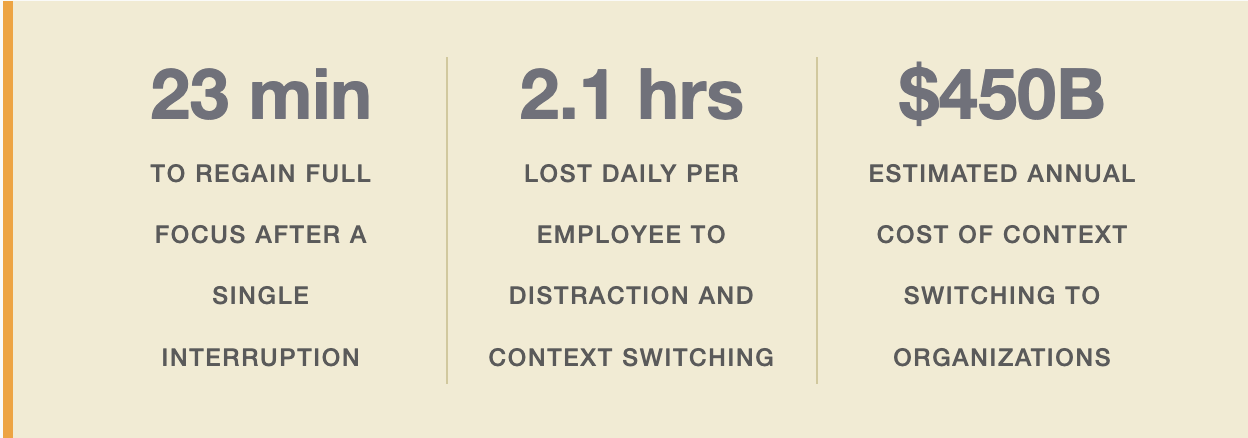
Distraction and context-switching aren’t minor inconveniences. Research from the University of California, Irvine shows that after a single interruption, it takes an average of 23 minutes to regain full focus. Microsoft’s 2025 Work Trend Index found that during core work hours, employees face a notification from meetings, emails, or chats every two minutes. Do the math: there literally aren’t enough hours in a workday to recover from all the interruptions that day contains.
And it isn’t just efficiency that suffers. A 2024 study found that heavy multitasking can temporarily reduce cognitive performance by the equivalent of 10 IQ points — more than the impact of missing a full night of sleep. The constant task-switching that defines a reactive workday doesn’t just make leaders less productive. It temporarily makes them less capable of the clear, strategic thinking their organizations depend on.
The problem isn’t a lack of effort. Most leaders are working extremely hard. The problem is a lack of intention about where that effort goes — and the systems to protect it.
“The key is not in spending time, but in investing it.”— Stephen Covey, The 7 Habits of Highly Effective People
A Four-Step System for Intentional Leadership
There is no perfect solution to the demands of modern leadership. Change is relentless and the volume of incoming priorities isn’t going to decrease. But what leaders can control is how they structure their own time and attention — and having a repeatable system makes all the difference between weeks that feel productive and weeks that feel like a pinball machine. Here’s the four-step approach we use and recommend.
1. Get clear on your actual priorities
Before you can protect your time, you have to know what you’re protecting it for. This sounds obvious, but in practice it’s rarer than it should be. Most leaders have a general sense of what matters, but haven’t translated that into a clear, ranked set of priorities that can survive a chaotic week. Without that clarity, the loudest or most recent demand wins — which is exactly how Pinball Syndrome takes hold.
The exercise is simple but requires genuine thought: sit down and ask yourself which parts of your work are most meaningful and most impactful. What would move the needle most significantly if you gave it sustained, focused attention? What are you doing right now that, if you’re honest, doesn’t belong in your calendar at all? Covey’s framework distinguishes between what is urgent and what is important — and the highest-value work for most leaders lives squarely in the important-but-not-urgent quadrant that reactive days never quite reach. Getting to that work starts with knowing exactly what it is.
2. Set tomorrow’s plan today — the afternoon before
The most underrated productivity habit for leaders is simple: before you close out each day, decide what tomorrow’s most important work is and write it down. Don’t wait until morning, when your inbox is already full and your attention is already fragmented. Make the decision in the relative calm of the afternoon before, when you have context on where the day ended and clarity on what needs to happen next.
The act of writing matters more than most people expect. Research by Dr. Gail Matthews at Dominican University found that people who write down their goals and priorities are 42% more likely to achieve them than those who simply think about them. Writing creates commitment. It moves a priority from an intention into a concrete plan — and it dramatically increases the likelihood that the plan survives contact with the next day’s demands.
3. Start with your top priority — before email, before messages
This is the step that most leaders know they should do and struggle most to execute. The instruction is straightforward: when you begin your workday, work on your most important priority first. Before you open email. Before you check messages. Before you respond to anything that came in overnight.
The reason this works comes down to cognitive science. As Asana’s research notes, the moment you open your inbox, you’ve handed control of your attention to other people’s agendas. Every email is someone else’s priority. Every notification is a competing demand. Starting with your own most important work — even for just 60 to 90 minutes before engaging with incoming communication — protects your best cognitive hours for your highest-value thinking. It produces a sense of early accomplishment that carries forward into the rest of the day. And over time, it shifts your identity from a leader who reacts to one who leads.
This is harder than it sounds, and it won’t happen perfectly every day. The goal isn’t perfection — it’s intention. Making it your default, even imperfectly, compounds into a meaningful difference in what gets done over weeks and months.
4. Check in with yourself throughout the day
The final step is the one that holds the system together: periodic self-check-ins throughout the day. Not elaborate reviews — just a brief, honest question every time you transition between tasks, get up for coffee, or finish a meeting: Am I working on the most important thing right now? How am I tracking against my plan?
This matters because even leaders with strong systems get pulled off course. Rabbit holes open up. An interesting but lower-priority problem captures attention. A colleague stops by. An email thread demands more time than it deserved. None of these are catastrophic on their own — but without a regular recalibration habit, they accumulate into an entire afternoon lost to drift. The check-in is the mechanism that catches the drift early, while there’s still time to course-correct, rather than discovering at 5 PM that the day went somewhere else entirely.
Why Systems Matter More Than Willpower
One of the most important insights about productivity is that relying on willpower to manage attention is a losing strategy. Willpower depletes. Decision fatigue is real. Harvard Business Review’s research on attention management argues that the most productive leaders aren’t those with more discipline — they’re those who have designed their environment and their routines to make the right choices the default ones, rather than relying on in-the-moment self-control.
That’s exactly what this four-step system does. It front-loads the decision-making (what’s most important, what’s the plan for tomorrow) to moments when cognitive resources are fresh and the pressure of the day hasn’t yet arrived. It removes the ambiguity that makes reactive behavior so tempting. And it creates a structure that can absorb the inevitable interruptions of a leadership role without losing the thread of what matters most.
The system doesn’t need to be rigid. Every leader will adapt it to their own context, their own rhythms, their own version of what “most important” means on any given day. The specific format matters less than the consistent practice. What we find consistently in our coaching work is that leaders who have any intentional system for managing their time and attention outperform those who are simply responding to the day as it arrives — regardless of raw talent, experience, or organizational resources.
The Four Steps — Quick Reference
- Get clear on your priorities. Know specifically what your highest-impact work is — not in general terms, but concretely enough to protect it against the week’s competing demands.
- Plan tomorrow the afternoon before. End each day by deciding what matters most tomorrow and writing it down. Don’t leave that decision to the morning, when the inbox has already set the agenda.
- Start with your top priority. Work on the most important thing first — before email, before messages, before the day has had a chance to redirect your attention.
- Check in with yourself. At every transition point in the day, ask: am I on track? If the answer is no, simply recalibrate and return to the plan. The habit of noticing drift is what prevents it from becoming permanent.
Covey was right. There is a meaningful difference between spending time and investing it. The leaders who feel most effective — not just most busy — are the ones who have found a system for protecting the former from the latter. Pinball Syndrome is the default. Intentional leadership is a choice, made deliberately, every day.
Try this system for one week. Not perfectly — just intentionally. Pay attention to what changes.
Lead with Intention, Not Reaction
Dame Leadership helps executives build the habits, systems, and clarity to spend their time where it drives the most impact. Let’s talk.