


There is a deeply embedded myth in leadership culture: that the harder you work, the better the results. Leaders wear busyness as a badge. Complexity signals seriousness. Full calendars feel productive. And when something isn’t working, the default instinct is to apply more effort — more meetings, more oversight, more process layers — until the problem is crushed under the weight of sheer output.
But what if that instinct is exactly wrong?
Greg McKeown — bestselling author of Essentialism and one of the most influential voices in leadership strategy today — makes a compelling case in his follow-up book, Effortless: Make It Easier to Do What Matters Most. His argument isn’t about working less. It’s about something far more useful for leaders: making the most important work the easiest work to accomplish. If Essentialism was about identifying the right things to focus on, Effortless is about doing those things the right way — with less friction, less exhaustion, and more lasting results.
This is a book worth putting in front of every leader who has ever felt like they’re sprinting hard but not moving fast enough.
The Burnout Problem Leaders Won’t Admit
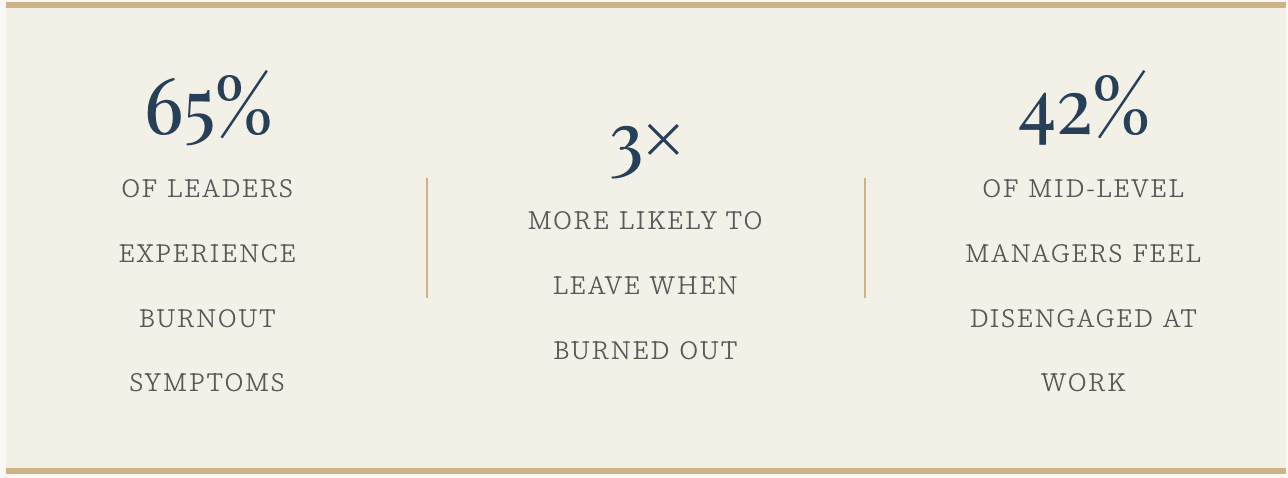
Before we talk about solutions, it’s worth naming the problem honestly. Leadership burnout is not a fringe issue. Research suggests that more than 65% of leaders experience burnout symptoms, contributing to poor decision-making, diminished team morale, and increased turnover at every level of the organization. A 2024 report found that leadership burnout rose to 56% across industries — and when leaders burn out, they are up to three times more likely to leave their organizations entirely.
The conventional wisdom says the answer is resilience — grit your teeth, build better habits, push through. McKeown’s insight is that this advice, while well-intentioned, often perpetuates the very problem it claims to solve. You cannot sustain high performance by doing more of the same thing that depleted you. At some point, the system itself needs to change — and that’s a leadership responsibility, not just a personal one.
“We’ve been taught that the more important the goal, the harder we must grind to achieve it. Effortless masterfully flips this script — arguing that the more essential the task, the more effortless we should make its completion.”— Cal Newport, author of Deep Work, on Effortless
The Steve Jobs Lesson Every Leader Needs
One of the most powerful illustrations in McKeown’s work comes from a story about Steve Jobs and the Apple engineering team. When tasked with building DVD burning software, the team went all in — features, customization options, bells, whistles, the works. When Jobs reviewed the product, he didn’t praise the thoroughness. He scrapped all of it.
His instruction was strikingly simple: put an icon on the desktop, drag files onto it, it burns them to a DVD. Done. Nothing more.
That moment captures the entire philosophy of Effortless in a single decision. Jobs wasn’t being dismissive of effort — he was exercising something far more sophisticated: the discipline to eliminate everything that wasn’t essential to the outcome. He understood that complexity isn’t a feature; it’s a cost. Every additional step, every added layer, every unnecessary decision extracts energy from the people who have to work within the system.
As a leader, your job isn’t to build the most impressive-looking process. It’s to build the one that reaches the right outcome with the least friction. And that requires actively questioning what can be removed — not just what can be added.
The Effortless Model: Three Layers of Change
McKeown structures his framework around three interconnected layers, each building on the last. Understanding how they work together is the key to applying them in practice.
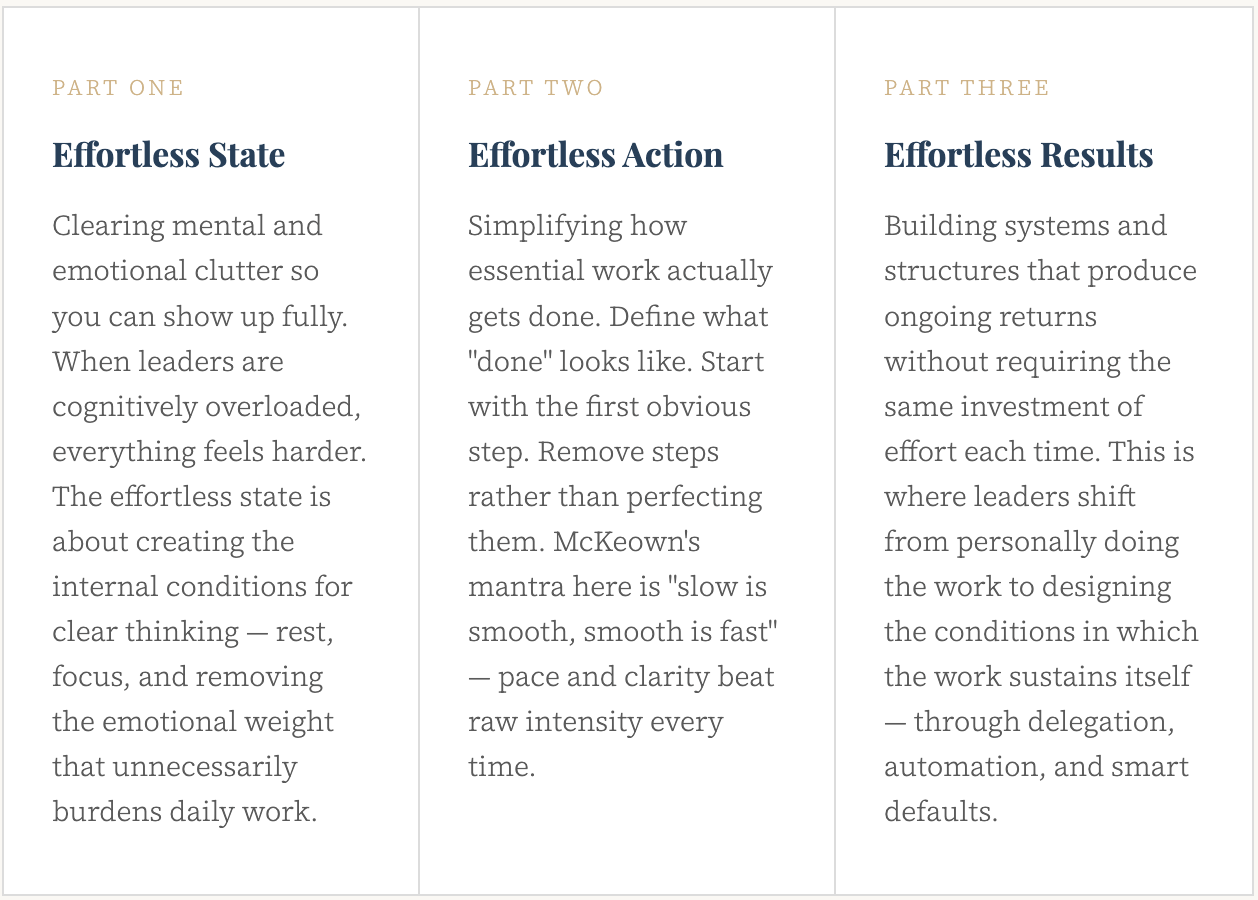
What’s important to notice about this model is that it doesn’t begin with process redesign — it begins with the leader’s own state. You cannot build an effortless organization from a place of personal depletion. The internal work comes first.
The Question That Changes Everything
McKeown offers one diagnostic question that leaders can return to again and again, for any challenge or initiative: “What would this look like if it were easy?”
It sounds deceptively simple. That’s the point. Most leaders are conditioned to ask how they can work harder, move faster, or add more resources to a problem. Asking what the easy version looks like forces a fundamentally different kind of thinking. It challenges assumptions about why the current approach exists in the first place — and creates space for solutions that effort alone would never uncover.
In our work with leaders and organizations, we’ve seen this single question open up significant breakthroughs. Not because it eliminates difficulty, but because it forces leaders to distinguish between difficulty that creates value and difficulty that is simply waste dressed up as rigor.
The “We’ve always done it this way” audit
One of the clearest signals that friction has become institutionalized is when a team can’t explain why something is done — only that it always has been. Processes accumulate. Approval layers compound. Meetings multiply. At some point, no one remembers what problem any of it was originally solving.
The antidote isn’t a top-down restructure. It’s a consistent habit of questioning. Encourage your team to surface these moments — not as complaints, but as opportunities. When someone says “we’ve always done it this way,” treat that as the start of a productive conversation, not the end of one. That phrase is one of the most reliable indicators of where your organization’s energy is being quietly drained.
Practical Starting Points for Leaders
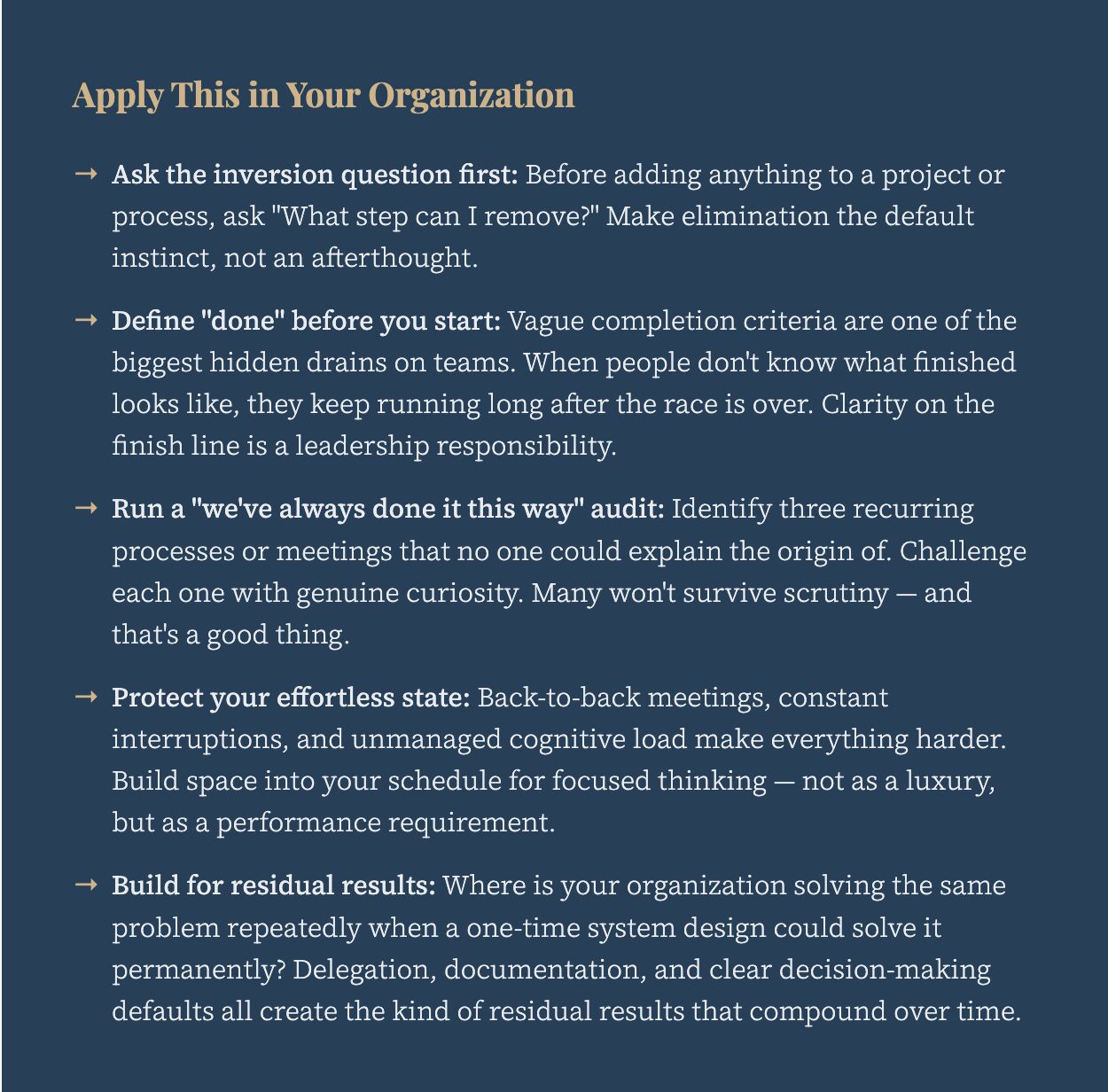
McKeown’s ideas are most powerful when they move from philosophy to practice. Here are the areas where we’ve seen leaders apply effortless thinking most effectively:
Effortless Leadership Is Not Easy Leadership
It’s worth being direct about what McKeown is not saying. He is not arguing that meaningful work requires no effort. He is not suggesting that leaders should opt for shortcuts over substance, or that every form of difficulty is avoidable.
What he is arguing — persuasively and with considerable evidence behind him — is that a significant amount of the difficulty leaders and organizations experience is manufactured. It comes from accumulated complexity, unclear goals, inherited processes, and a cultural bias that treats effort as proof of commitment. Stripping that manufactured difficulty away doesn’t make the work less serious. It makes room for the kind of clear, focused energy that actually produces lasting results.
“Essentialism is about doing the right things. Effortless is about doing them the right way.”— Greg McKeown
The leaders we admire most are rarely the ones who appear the busiest. They are the ones who seem clear. Their teams know what they’re working toward and why. Decisions have conviction. Work has momentum. That clarity isn’t accidental — it’s the product of intentional simplification, practiced consistently over time.
Effortless deserves space on every leader’s shelf, not just for the tactical advice it offers, but for the mindset shift it invites. We’d also recommend pairing it with McKeown’s first book, Essentialism: The Disciplined Pursuit of Less — together, they form one of the most complete frameworks for sustainable, high-impact leadership we’ve come across.
Ready to Lead with Less Friction?
Whether you’re developing emerging leaders or strengthening your executive team, we help organizations build the clarity and systems that make great work sustainable. Connect with us.